Thursday, August 29, 2013

Fall Funfest All Breeds Horse Show

Fall Funfest All Breeds Horse Show - September 1st


Spectators are welcome to attend the Annual Fall Funfest All Breeds Horse Show on Sunday, September 1st from 8:00 am to 4:00 pm at the McCoy Equestrian & Recreation Center, 14280 Peyton Drive.

Wednesday, August 28, 2013

The results are out for Fannie Mae’s program that recognizes top performing servicers.

Known as the Servicer Total Achievement and Rewards, or STAR, the program was created to establish servicing standards and acknowledge Fannie Mae servicers that stand out for their performance, customer service, and foreclosure prevention efforts, according to a release.
Only servicers with STAR scorecard results that are at or above median levels compared to those in their peer group receive recognition. Servicers were broken down into different peer groups based on portfolio composition and size. Servicers in peer group one have more than 215,000 Fannie Mae loans, group two has more than 75,000 loans, while group three has at least 500 seriously delinquent Fannie Mae loans.
Servicers recognized for the first half of 2013 in peer group one were Green Tree Servicing, Nationstar Mortgage, Ocwen Financial, PHH Mortgage, PNC Financial Services Group, Seterus, and Wells Fargo.
In peer group two, Fannie Mae gave a nod to Fifth Third Bank and Regions Bank.
Meanwhile, servicers acknowledged in the third group were Capital One, Colonial Savings, M&T Bank, Navy Federal Credit Union, Sovereign Bank, and Third Federal Savings and Loan.
For the first time, the 2013 midyear results also included key metrics to measure servicer performance and foreclosure prevention efforts.
“Our mortgage servicers’ efforts are critical to keeping people in their homes, preventing foreclosures and stabilizing communities,” said Leslie Peeler, SVP of Fannie Mae’s national servicing organization. “With our expanded 2013 mid-year assessment, we continue to recognize servicers that are on track to meet overall performance scorecard goals while also recognizing more servicers that are top performers in specific operational areas. We are working hard to share more information regarding our STAR assessment process so the industry can more easily identify and adopt best practices for the benefit of homeowners.”
The specific metrics used to examine performance and foreclosure prevention results were ability to assist 90-plus delinquent borrowers; efficiency when helping borrowers retain their homes; and liquidation efficiency when handling short sales and deeds-in-lieu.
Among those three metrics, Fannie Mae recognized servicers who showed leading performance when compared to their peer groups.
Three servicers were recognized for their ability to handle 90-plus delinquent accounts: Seterus, Regions Bank, and Branch Banking & Trust Company.
Seterus also stood out for retention efficiency, along with OneWest Bank and Colonial Savings.
The servicers that were acknowledged for liquidation efficiency were GreenTree Servicing, Fifth Third Bank, and Navy Federal Credit Union.

Monday, August 26, 2013

RIVERSIDE: Ontario airport is focus of city talks

RIVERSIDE: Ontario airport is focus of city talks
  Send to a Friend
Joyce Dow
Crossline Capital
Phone: (909) 467-2000
Fax:
jdow@crosslinecapital.com


In This Issue 
Last Week in Review: Housing news was front and center, plus the minutes from the Fed's July meeting were released.

Forecast for the Week: The last week of August brings some key reports, with news on inflation, Gross Domestic Product, Consumer Confidence, and more.

View: If you use your mobile phone for work calls, there are some easy ways to save minutes and money.
Last Week in Review 
"I'm on my way...just set me free...home sweet home." The lyrics from Motley Crue's Home Sweet Home sound like a tune the housing market could be singing, as the news shows that the housing sector continues to recover--for the most part.

Existing Home Sales rose by 6.5 percent in July from June and are up 17.2 percent since this time last year. In addition, the Federal Housing Finance Agency reported that home prices rose 7.7 percent in the year ended in June. From May to June, prices rose by 0.7 percent. However, New Home Sales dropped 13.4 percent in July from June, below expectations, and June's numbers were also revised lower.

Also of note last week, the minutes from the Fed's July meeting of the Federal Open Market Committee were released--and they offered no clarity as to when the Fed will begin tapering its Bond purchases. Remember that the Fed has been buying $85 billion of Bonds a month to help stimulate the economy and housing market. This includes Mortgage Bonds, to which home loan rates are tied, and these purchases have helped home loan rates remain attractive.

The Fed has said the rate of its purchases will continue to depend on economic data, and could be increased or decreased accordingly. Jobs data is one area the Fed will be watching especially closely. And last week, there was a jump in weekly Initial Jobless Claims, which rose by 13,000 to 336,000. Though this was in line with estimates and the figure remains near post-recession lows, it is the highest level in a month. However, the 4-week average, which evens out seasonal abnormalities, fell to 330,500, near 6-year lows.

What does this mean for home loan rates? Economic data in the coming weeks will be a key factor in whether the Fed begins tapering its Bond purchases as early as its meeting in mid-September, or if it waits until later in the year or even 2014. This timing could pay a big role in the direction Bonds and home loan rates move in the months ahead.

The bottom line is that home loan rates remain attractive compared to historical levels and now remains a great time to consider a home purchase or refinance. Let me know if I can answer any questions at all for you or your clients.

Forecast for the Week 
The calendar is busy this week, with important news from start to finish.
  • The week kicks off Monday with Durable Goods Orders, which are orders for items that last for an extended period of time.
  • In housing news, the S&P/Case-Shiller Home Price Index will be released on Tuesday.
  • Consumer Confidence will also be released on Tuesday with the Consumer Sentiment Index following on Friday.
  • As usual, Weekly Initial Jobless Claims will be released on Thursday, as claims hover near six-year lows.
  • Also on Thursday, Gross Domestic Product for the second quarter will be closely watched for any signs of an uptick in economic growth. The initial reading was a rather weak 1.7 percent.
  • Ending the week on Friday, we'll see Personal Consumption Expenditures, the Fed's favorite read on inflation, along with Personal IncomePersonal Spending, and Chicago PMI data.
Remember: Weak economic news normally causes money to flow out of Stocks and into Bonds, helping Bonds and home loan rates improve, while strong economic news normally has the opposite result. The chart below shows Mortgage Backed Securities (MBS), which are the type of Bond that home loan rates are based on.

When you see these Bond prices moving higher, it means home loan rates are improving -- and when they are moving lower, home loan rates are getting worse.

To go one step further -- a red "candle" means that MBS worsened during the day, while a green "candle" means MBS improved during the day. Depending on how dramatic the changes were on any given day, this can cause rate changes throughout the day, as well as on the rate sheets we start with each morning.

As you can see in the chart below, Bonds were able to stabilize last week. Home loan rates remain attractive and I will continue to monitor them closely.

Chart: Fannie Mae 4.0% Mortgage Bond (Friday Aug 23, 2013)
Japanese Candlestick Chart
The Mortgage Market Guide View... 
How to Make Free Calls
Software and apps you can install on your computer or smart phone can help you save money on calls.
By Cameron Huddleston, Kiplinger.com

You've likely heard that ditching your landline is a good money-saving move. But if you're relying on your mobile phone to make all your calls, you might have to pay more to get unlimited minutes. So to keep costs down, consider using a free Internet calling service. There are several you can download to your computer, smart phone or tablet. These services also are ideal for people who make international calls and for college students who want to keep in touch with friends and families. Because they're free, you can try out all of the services below to see which works best for you.

Skype. To use Skype, you need an Internet connection and a computer or mobile device with a microphone and speakers. It only takes a few minutes to install it and create an account with a username that will serve as your contact information (rather than a phone number). Then you can make free voice and video calls (if you have a webcam) to other Skype users. You also can use Skype for instant messaging and file sharing.

Viber. Unlike Skype, Viber doesn't require you to create an account with a username. Instead, it uses your mobile phone number. So you must first install it on your smart phone. Then you can install it on your computer if you want. In addition to free voice and video calls, Viber offers free text and photo messaging and location sharing with other Viber users. Just make sure you use a Wi-Fi connection rather than 3G so you don't use your phone's data.

Vonage Mobile. This relatively new Android and iPhone app lets users make free voice and video calls and send free text messages to others with the app. You also can use it to make free calls to Vonage home phone customers. Like Viber, it uses your mobile phone number as your caller ID.

Reprinted with permission. All Contents ©2013 The Kiplinger Washington Editors. Kiplinger.com.

Economic Calendar for the Week of August 26 - August 30
Date
ET
Economic Report
For
Estimate
Actual
Prior
Impact
Mon. August 26
08:30
Durable Goods Orders
Jul
NA
 
3.9%
Moderate
Tue. August 27
09:00
S&P/Case-Shiller Home Price Index
Jun
NA
 
12.2%
Moderate
Tue. August 27
10:00
Consumer Confidence
Aug
NA
 
80.3
Moderate
Wed. August 28
10:00
Pending Home Sales
Jul
NA
 
-0.4%
Moderate
Thu. August 29
08:30
GDP Chain Deflator
Q2
NA
 
0.7%
Moderate
Thu. August 29
08:30
Gross Domestic Product (GDP)
Q2
NA
 
1.7%
Moderate
Thu. August 29
08:30
Jobless Claims (Initial)
8/24
NA
 
NA
Moderate
Fri. August 30
08:30
Personal Income
Jul
NA
 
0.3%
Moderate
Fri. August 30
08:30
Personal Spending
Jul
NA
 
0.5%
Moderate
Fri. August 30
08:30
Personal Consumption Expenditures and Core PCE
Jul
NA
 
0.2%
HIGH
Fri. August 30
08:30
Personal Consumption Expenditures and Core PCE
YOY
NA
 
1.2%
HIGH
Fri. August 30
08:30
Consumer Sentiment Index (UoM)
Aug
NA
 
80.0
Moderate
Fri. August 30
09:45
Chicago PMI
Aug
NA
 
52.3
HIGH


The material contained in this newsletter has been prepared by an independent third-party provider. The content is provided for use by real estate, financial services and other professionals only and is not intended for consumer distribution. The material provided is for informational and educational purposes only and should not be construed as investment and/or mortgage advice. Although the material is deemed to be accurate and reliable, there is no guarantee it is without errors.

As your mortgage professional, I am sending you the MMG WEEKLY because I am committed to keeping you updated on the economic events that impact interest rates and how they may affect you.

Thursday, August 22, 2013

Ontario, California Real Estate Loans


 In This Issue  
   
 Last Week in Review: Positive economic data capped a rough week for Mortgage Bonds and home loan rates, despite tame inflation data.

Forecast for the Week: Housing news and the Fed meeting minutes highlight a quiet economic calendar.

View: Knowing the difference between action and activity can make a big difference in achieving your goals. The easy tips below can help.


 Last Week in Review  
   
 "If you build it, they will come." And while that line from the movie Field of Dreams may have referred to a baseball field, after last week's news it could also apply to the housing market.

The housing sector continues to improve despite the recent rise in home loan rates, as Housing Starts rose 5.9 percent from June to July to 896,000 on an annualized basis. This was in line with estimates. Building Permits, a sign of future construction, were up 2.7 percent, coming in above expectations. In addition, the National Association of Home Builders Housing Market Index rose to 59 in August from the 57 recorded in July. This is the best level in nearly eight years.

Retails Sales for July were also positive, rising for the fourth straight month. When stripping out autos, sales surged by 0.5 percent, the fastest pace this year. And there was good news for the labor market, as Weekly Initial Jobless Claims fell to 320,000, a level not seen since October 2007. There were no apparent seasonal distortions in the numbers. In the manufacturing sector, Empire State Manufacturing came in above expectations, while the Philadelphia Fed Index came in just below expectations.

What does this mean for home loan rates? Remember that the Fed has been buying $85 billion of Bonds a month to help stimulate the economy and housing market. This includes Mortgage Bonds, to which home loan rates are tied, and these purchases have helped home loan rates remain attractive.

The Fed has said the rate of its purchases will continue to depend on economic data, and could be increased or decreased accordingly. Rest assured that the Fed was watching all the good economic reports from last week very closely. The data that continues to come in will be a key factor in whether the Fed begins tapering these purchases as early as its meeting in mid-September, or if it waits until later in the year or even 2014.

One thing that is also important to note--inflation at both the wholesale and consumer levels remains tame, as evidenced by the Producer and Consumer Price Indexes for July. This gives the Fed cover to continue its Bond purchases if economic data takes a turn for the worse.

The bottom line is that now remains a great time to consider a home purchase or refinance, as home loan rates remain attractive compared to historical levels. Let me know if I can answer any questions at all for you or your clients.


 Forecast for the Week  
   
 The economic calendar is quiet this week, but the Fed meeting minutes could move the markets.
  • Housing data is front and center, with Existing Home Sales on Wednesday and New Homes Sales on Friday.
  • The only other report of significance is Thursday's Weekly Initial Jobless Claims.
In addition, the minutes from the Fed's latest Federal Open Market Committee meeting will be released on Wednesday at 2:00 p.m. ET. If the minutes hint that the Fed may start tapering its Bond purchases after its September meeting, this could cause volatility to ramp up to an extremely high level.

Remember: Weak economic news normally causes money to flow out of Stocks and into Bonds, helping Bonds and home loan rates improve, while strong economic news normally has the opposite result. The chart below shows Mortgage Backed Securities (MBS), which are the type of Bond that home loan rates are based on. 

When you see these Bond prices moving higher, it means home loan rates are improving -- and when they are moving lower, home loan rates are getting worse.

To go one step further -- a red "candle" means that MBS worsened during the day, while a green "candle" means MBS improved during the day. Depending on how dramatic the changes were on any given day, this can cause rate changes throughout the day, as well as on the rate sheets we start with each morning.

As you can see in the chart below, last week was a rough one for Mortgage Bonds and home loan rates. I'll be watching the news closely to see if economic reports continue to be positive...and if there is more talk of the Fed's tapering its Bond purchases in September.

Chart: Fannie Mae 3.5% Mortgage Bond (Friday Aug 16, 2013)
Japanese Candlestick Chart
 
   
 The Mortgage Market Guide View...  
 
   
 Activity or Action
Do You Know the Difference?
The words activity and action sound similar, and are sometimes used as synonyms. To a casual observer, there may not be any visual difference between one person's activity and another'saction. Yet when it comes to reaching goals in business or life, activity and action are two very different things.

So what's the difference? 
Activity is 'doing', it has no destination, it is an expense of energy. Action is 'accomplishing', it is based on a plan, it builds its own momentum. Here are a few examples to help clarify:

Activity: Making a New Year's resolution. Action: Stop smoking.

Activity: Planning a newsletter to clients. Action: Send a newsletter to clients.

Activity: Researching gym memberships. Action: Exercise.

Activity: Reading diet books. Action: Eat healthy.

Is activity bad? 
Absolutely not. We need to plan, and activity is an essential step in the process. This is the appropriate place to prepare, research, study, set goals, or create a vision. Still, it's a preliminary step, and that's where people tend to get stuck. (Did you ever notice how busy you feel when you're procrastinating?)

In reality, activity is only preparation for the actions that will make a difference in your life and career.

How to take more action:
If activity has become your preferred form of procrastination, here's what to do:

Schedule it. Schedule everything from working out, to writing prospecting emails, to sending newsletters. Remember, don't use this time for planning goals, use it for taking actions that move your goals ahead.

Pick a date. For larger scale goals or projects requiring more planning, it's good to put your deadline in your calendar. Schedule all the pieces as they come up, but stick to your deadline.

Tell somebody. Always try to build accountability into taking action. Make both your goals and your deadlines public by telling a close friend, a mentor, posting it on Facebook, or even enlisting as many people as you can. There's pressure, but it's the good kind!

Don't forget to pass these helpful tips along to your clients and colleagues.

Economic Calendar for the Week of August 19 - August 23
Date
ET
Economic Report
For
Estimate
Actual
Prior
Impact
Wed. August 21
10:00
Existing Home Sales
Jul
5.20M
 
5.08M
Moderate
Wed. August 21
02:00
FOMC Minutes
7/31
NA
 
NA
HIGH
Thu. August 22
08:30
Jobless Claims (Initial)
8/17
337K
 
320K
Moderate
Fri. August 23
10:00
New Home Sales
Jul
490K
 
497K
Moderate

Tigar Event to learn about Envioromental and Natural Issues. Free Event


Wednesday, August 14, 2013

Home Values are going up!  
Tami GlassFernandes
Crossline Capital, Inc  Ontario California Branch
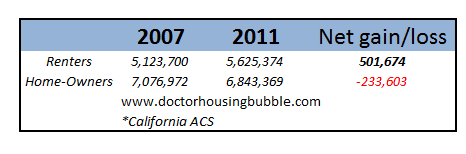
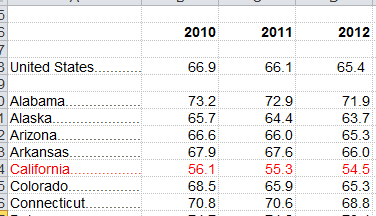
The California housing market is providing us with two different pictures.  First, home prices have surged and inventory is still very low (although increasing from the spring low).  However, the homeownership rate continues to decline from the peak reached in 2006 of 60.2 percent.  Today the California homeownership rate is 54.5 percent.  How big of a difference is this?  Since 2007 California has added a net of 500,000 renter households while losing a net of 233,000 homeowners.  Yet the market continues to boom in the face of a declining homeownership rate.  As we look at the market today we start seeing a slowdown in the speed in which flips are being accepted and inventory is rising.  With higher interest rates and the fall season just before us, will the market thaw or continue to accelerate?

Taking account
It might be useful to take into account what has occurred in the last few years in regards to the status of occupied-housing in California:
renter homeowner california
California has added a significant number of renters over this period.  Many of these people lost their homes via foreclosure and simply shifted to renting their place of occupancy.  What is interesting is the number of renters being added has only increased.  The above data is from the Census ACS that came out in September of 2012 (the full 2012 data should be out in fall of 2013).  The above figures were calculated when California had a 55.3 homeownership rate (the latest figure is 54.5 percent):
homeownership rate california
One of the big reasons for this shift has certainly come from investors purchasing homes for rent.  In more typical markets, a home is sold and then another one is usually bought (two transactions are generated).  In the recent market with many foreclosures, you had someone losing their home and then someone buying it from the bank (which was a one-and-done transaction if it then became a rental).  This was likely the case in many areas including the Sacramento area and also the Inland Empire.  I know of a few people that bought in Los Angeles and Orange County for these purposes but their rental yields were extremely low.
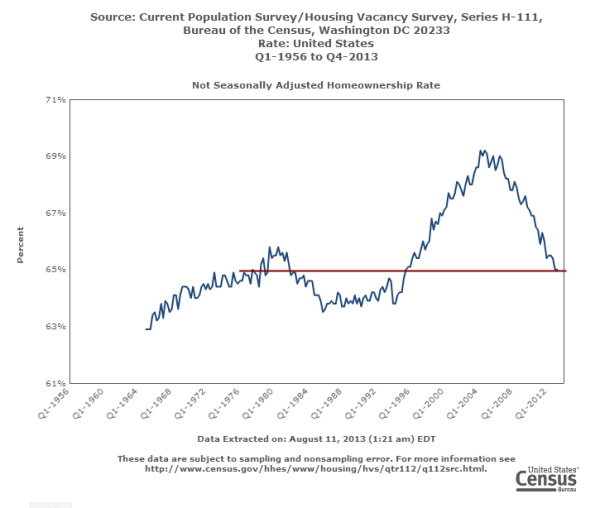
This trend to a lower homeownership rate is not only specific to California.  It is a nationwide trend:
homeownership rate
The homeownership rate today is back to where it was in the mid-1990s or if you go further back, to what it was in the late 1970s.  In California home prices are in a manic like acceleration upwards.  The median home price in the state is up a record 28.5 percent over the year:
Median price:
May 2012             $274,000
May 2013:           $352,000
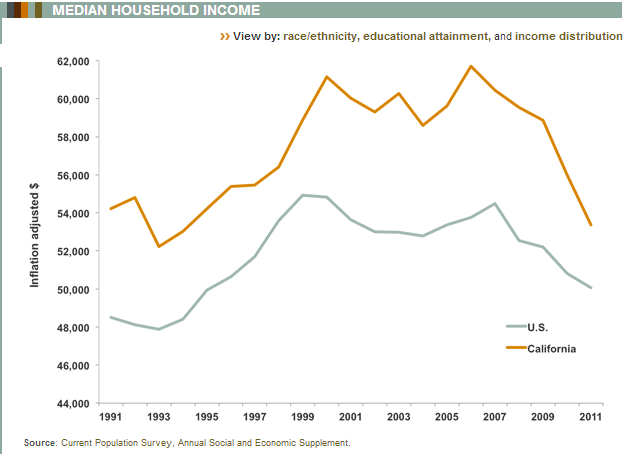
Home prices went up by $78,000 across the state while incomes look like this:
california incomes
To put it another way, a California family would do better by simply sitting in their home generating “equity” instead of working.  This is starting to sound very familiar since many of the ancillary businesses are now starting to rev up and once again have become very real estate dependent.  For example, banks are living high on the hog with low rates and a continual stream of refinances.  Fees and leverage allowed for record profits once again.  We are even seeing a few of our favorite loans cropping up once again as well.
Yet the change in California is symbolic of a bigger trend nationwide.  Fewer and fewer people will be able to live what they think of as a middle class lifestyle in more expensive regions.  And the legions of poor are also growing.  In 2008, California had 2,220,127 people of food assistance.  Today it is closer to 4,000,000 (a jump of 80 percent in roughly four years).  This is in the same state that saw an overall median price jump of 28.5 percent.
The unsold inventory index is down to around 2.9 months which indicates tight conditions for anyone looking to buy.  While the talk is heating up, the facts show that hundreds of thousands of Californians have now become renters versus homeowners.  A few open houses seemed a bit calmer this month but only by a little.
What are you seeing in your local real estate market?

Chino Farmer Market is a good place to Shope for all kinds of fun stuff!

Monday, August 12, 2013

Last Week in Review: The housing market continues to improve, plus the tapering talk carried on.

Forecast for the Week: A busy week is ahead, with important inflation, manufacturing and housing news being released.

View: Staying sharp is important for today's busy professionals. Check out the simple tips below.
Last Week in Review 
"Every day you make progress." Winston Churchill. And the housing market continues to progress in the right direction. Read on for details.

Last week, research firm CoreLogic reported that home prices across the U.S. rose by nearly 12 percent from June 2012 to June 2013. By comparison, home prices only rose 3.76 percent from June 2011 to June 2012. In addition, research and analytics firm Clear Capital said that prices rose 9.3 percent in the year ended in July.

The housing markets have turned the corner to greener pastures, but it's important to note that this pace of growth may be unsustainable. With home loan rates rising over the past several months, this rate of appreciation could slow.

In labor market news, Weekly Initial Jobless Claims rose by 5,000 in the latest week to 333,000, but this was below the 340,000 expected. This followed the Jobs Report for July, which was a bit of a disappointment with less jobs created than expected.

What does this mean for home loan rates? One of the biggest questions on everyone's mind is: When will the Fed start tapering their Bond purchases? Remember that the Fed has been buying $85 billion of Bonds a month to help stimulate the economy and housing market. This includes Mortgage Bonds, to which home loan rates are tied, and these purchases have helped home loan rates remain attractive.

The Fed has said the rate of their purchases will continue to depend on economic data, and could be increased or decreased accordingly. Last week, several Fed members spoke out in favor of tapering these purchases as early as the Fed's meeting in mid-September. However, with our economy growing at sub 2 percent, economic data between now and September will be a key factor in this decision.

The bottom line is that home loan rates remain attractive compared to historical levels and now remains a great time to consider a home purchase or refinance. Let me know if I can answer any questions at all for you or your clients.

Forecast for the Week 
After last week's slow calendar, this week features a steady stream of reports.
  • Economic data kicks off on Tuesday with Retail Sales for July. This comes after a decent reading in June.
  • Inflation data from the wholesale-measuring Producer Price Index and the Consumer Price Index will be released on Wednesday and Thursday, respectively.
  • In the manufacturing sector, the Empire State Index and Philadelphia Fed Index will be released on Thursday along with Weekly Initial Jobless Claims.
  • To round out the week, Housing StartsBuilding Permits and Consumer Sentiment will be disseminated on Friday.
Remember: Weak economic news normally causes money to flow out of Stocks and into Bonds, helping Bonds and home loan rates improve, while strong economic news normally has the opposite result. The chart below shows Mortgage Backed Securities (MBS), which are the type of Bond that home loan rates are based on.

When you see these Bond prices moving higher, it means home loan rates are improving -- and when they are moving lower, home loan rates are getting worse.

To go one step further -- a red "candle" means that MBS worsened during the day, while a green "candle" means MBS improved during the day. Depending on how dramatic the changes were on any given day, this can cause rate changes throughout the day, as well as on the rate sheets we start with each morning.

As you can see in the chart below, Bonds have improved from multi-year lows in recent weeks. I'll be watching closely to see if they can improve further.

Chart: Fannie Mae 3.5% Mortgage Bond (Friday Aug 09, 2013)
Japanese Candlestick Chart
The Mortgage Market Guide View... 
Brain Breakthroughs

Many people think intellect is a matter settled at birth, and mistakenly believe there's no way to boost their brain brilliance. But scientific studies prove just the opposite. In fact, small lifestyle adjustments combined with a few mental gymnastics can not only increase intelligence, but also improve general brain health, helping prevent aging disorders, such as Alzheimer's disease.

According to most neurologists, the key is staying mentally active, whatever your age. The following tips will help boost your mental acuity and increase your intelligence.

All You Have To Do Is Dream. An adequate amount of restful sleep is an important component of brain function (its effect on memory and learning is contested among scientists). Restful sleep provides energy as well as the ability to focus, both vital factors in achieving mental stimulation. Some studies have also shown the reverse to be true, that is, that more mental stimulation during the day gives you better sleep at night.

Jumpin' Jack Flash Memory. Exercise brings oxygen-rich blood to the brain and regulates blood-sugar levels. Exercises such as aerobics, dance, and martial arts all require memorization and are great for promoting mental stimulation. They also help to develop the rhythm and timing circuitry that runs across multiple regions of the brain.

Playing Those Mind Games Together. Crossword puzzles and Sudoku, board games and card games are all excellent for mental stimulation--now you can add video games to the list. Each type of game makes various demands on brain function such as recall, hand-eye coordination, attention, memory, logic, and pattern recognition. The key here is to keep upping the skill or level of challenge as you progress.

Don't forget to pass these helpful tips along to your clients and colleagues.

Economic Calendar for the Week of August 12 - August 16
Date
ET
Economic Report
For
Estimate
Actual
Prior
Impact
Tue. August 13
08:30
Retail Sales
Jul
NA
 
0.4%
HIGH
Tue. August 13
08:30
Retail Sales ex-auto
Jul
NA
 
0.0%
HIGH
Wed. August 14
08:30
Producer Price Index (PPI)
Jul
NA
 
0.8%
Moderate
Wed. August 14
08:30
Core Producer Price Index (PPI)
Jul
NA
 
0.2%
Moderate
Thu. August 15
08:30
Empire State Index
Aug
NA
 
9.4
HIGH
Thu. August 15
08:30
Core Consumer Price Index (CPI)
Jul
NA
 
0.2%
HIGH
Thu. August 15
08:30
Consumer Price Index (CPI)
Jul
NA
 
0.5%
HIGH
Thu. August 15
08:30
Jobless Claims (Initial)
8/10
NA
 
333K
Moderate
Thu. August 15
10:00
Philadelphia Fed Index
Aug
NA
 
19.8
HIGH
Fri. August 16
08:30
Housing Starts
Jul
NA
 
836K
Moderate
Fri. August 16
08:30
Building Permits
Jul
NA
 
911K
Moderate
Fri. August 16
08:30
Productivity
Q2
NA
 
0.5%
Moderate
Fri. August 16
10:00
Consumer Sentiment Index (UoM)
Aug
NA
 
83.1
Moderate


The material contained in this newsletter has been prepared by an independent third-party provider. The content is provided for use by real estate, financial services and other professionals only and is not intended for consumer distribution. The material provided is for informational and educational purposes only and should not be construed as investment and/or mortgage advice. Although the material is deemed to be accurate and reliable, there is no guarantee it is without errors.

As your mortgage professional, I am sending you the MMG WEEKLY because I am committed to keeping you updated on the economic events that impact interest rates and how they may affect you.

Mortgage Market Guide, LLC is the copyright owner or licensee of the content and/or information in this email, unless otherwise indicated.   Mortgage Market Guide, LLC does not grant to you a license to any content, features or materials in this email.   You may not distribute, download, or save a copy of any of the content or screens except as otherwise provided in our Terms and Conditions of Membership, for any purpose.

Tuesday, August 6, 2013

Housing news dominated the headlines this morning with positive home price data hitting the wires. First up was CoreLogic reporting that its national Home Price Index on a year-over-year basis in the month ended in June rose by nearly 12% as the sector continues to improve. From May to June, prices rose by almost 2%. In addition, home prices are expected to rise by 12.5% year-over-year basis in July. However, prices are still down 19% from their peak hit back in April 2006. All of the figures include distressed sales.
To further bolster price appreciations in housing, Clear Capital reported that national home prices surged 9.3% in July 2013 from July 2012 and gained 1.6% over the last quarter. Clear Capital did say that prices remain 33.4% below peak values. For the last half of 2013, the firm sees a moderation in home price trends.
President Obama will be in Phoenix, Arizona later today speaking on the housing market and in particular, the future fate of Fannie Mae and Freddie Mac. The government bailed out the two mortgage giants to the tune of nearly $200 billion after the housing market collapsed in 2008 and the plan is for their roles to diminish and let private sector capital take on a bigger role in the mortgage market.